

Music can change the feel of an advertisement in seconds.
But when a business needs music for an ad, there is an important choice to make: use stock music or have something created specifically for the brand?
Stock music is usually faster and cheaper. Custom business music costs more, but it can be built around your brand and become a recognisable asset you can reuse.
Neither option is automatically right for every advertisement. The better choice depends on what you need the music to do.
What is stock music?
Stock music is pre-made music licensed for use in videos, advertisements and other content.
You browse a library, choose a track that fits the mood and obtain the licence required for your intended use.
It is popular because it is quick. You can often find something suitable without waiting for music to be written and produced.
For many everyday videos, that convenience is valuable.
What is a custom business soundtrack?
A custom business soundtrack is music created specifically for a business, brand or campaign.
Instead of searching for a track that happens to fit, the music can be shaped around the business itself.
That might include its personality, audience, business name, marketing message or the feeling it wants customers to associate with the brand.
A custom soundtrack can be instrumental, include vocals or become a full advertising jingle.
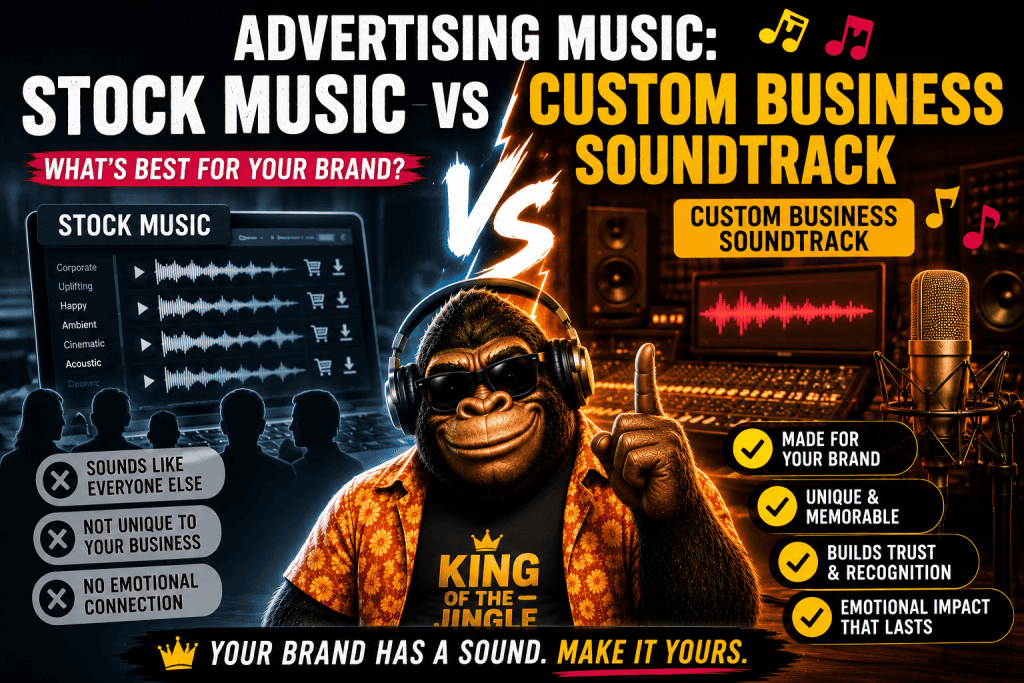
Stock music vs custom music at a glance
The main difference is purpose.
Stock music is created to be useful to many different customers. Custom music is created for one particular business.
- Stock music: fast, affordable and useful for general background music.
- Custom music: unique to the project and better suited to building a recognisable business sound.
If you only need atmosphere for one video, stock may be enough.
If you want the music itself to become part of your brand, custom music has a different value.
Which option costs less?
Stock music will usually have the lower upfront cost.
Depending on the library, you might pay for an individual licence or access music through a subscription.
Custom music involves creative and production work, so the initial cost is normally higher.
But upfront price is only one part of the comparison.
If a custom track is reused across social videos, advertising, YouTube, website content and other marketing, the cost can be spread across many uses.
Before buying either option, check exactly what the licence allows.
I have covered custom pricing in more detail in How Much Does a Custom Jingle Cost in Australia?
Which is better for brand recognition?
Custom music has the advantage here because it can contain distinctive elements created around the business.
A stock track may fit your advertisement perfectly, but other businesses may also be able to license the same track.
That makes it harder for the sound itself to belong to you.
Custom music can include a recognisable melody, rhythm, sung business name or musical hook that appears repeatedly across your marketing.
Over time, that can become part of your audio branding.
Does stock music make an ad less effective?
No.
Stock music can work very well when the track supports the message and the advertisement does not need the music to identify the brand.
A strong ad with suitable stock music can easily be better than a weak ad with custom music.
The question is not whether stock music is good or bad.
The question is what job you expect the music to perform.
If its job is simply to create energy, emotion or atmosphere, stock can be a practical choice.
If its job includes helping people recognise your business, custom music gives you more control.
Can competitors use the same stock music?
Often, yes.
Most stock music is licensed non-exclusively, which means multiple customers can use the same track under the licence terms.
That does not mean your direct competitor will definitely choose it, but the possibility exists.
You may also hear a track you have used appearing in another advertisement, YouTube video or social post.
For background music, that may not matter.
For a distinctive brand asset, it matters much more.
What about exclusive stock music?
Some music services offer exclusive licences, customisation or tracks with more restricted availability.
Those options can reduce some of the drawbacks of standard stock music, but they may also increase the cost.
Always read the actual licence rather than assuming a track is exclusive because it feels unusual.
Which gives you more creative control?
Custom music gives you more control because the project starts with your brief.
You can discuss the business personality, target audience, intended platforms and what you want customers to remember.
With stock music, you work in the opposite direction. The music already exists, so you search until you find something close to what you need.
Sometimes that is perfectly efficient.
Other times, you end up changing the video to suit the music instead of having the music support the video.
Which is faster?
Stock music wins on speed.
If you need a track today, a good music library can let you search, license and start editing quickly.
Custom music takes time because somebody has to understand the brief, create the idea, produce the track and handle any revisions.
If your deadline is extremely tight, stock music may be the sensible choice.
If the campaign is planned in advance and the music has a larger branding role, the extra creation time can be worthwhile.
What about revisions?
You normally cannot ask a stock track to become a different song.
You may be able to edit its length or use alternate versions supplied by the library, depending on the licence and files provided.
With custom music, revisions can be part of the creative process.
The number and type of revisions depend on the provider, so check this before ordering.
If you are commissioning a jingle, my guide to getting a custom jingle made explains what to prepare before the project begins.
Which works better across several ads?
This is where custom music can become especially useful.
Your campaigns may change, but a recognisable musical element can stay consistent.
You could use a full version in one advertisement, an instrumental edit in another and a five-second hook at the end of a third.
The advertisements do not have to look or sound identical. The common audio cue connects them.
That can help turn music from a one-off production choice into a reusable marketing asset.
Can stock music be reused?
Often, yes, but it depends on the licence.
Some licences cover multiple projects while others have limits based on the project, platform, audience size, advertising spend or type of distribution.
Subscription services can also have rules about what happens to existing projects after a subscription ends.
Check the licence for the specific service you use.
Do not assume that paying once means unlimited use forever.
Can custom music be reused?
It can be, if your agreement gives you the necessary rights.
When commissioning custom business music, explain where you expect to use it.
That may include:
- organic social media
- paid social advertising
- YouTube
- website videos
- radio
- podcasts
- events
- in-store content
Knowing the intended uses early helps avoid confusion later.
What should you use for social media ads?
Both options can work.
Stock music can be useful for fast campaigns, tests and content where the music is mainly creating mood.
Custom music becomes more useful when you run ads regularly and want viewers to start recognising the sound of your business.
A short branded hook can also be adapted across different campaigns rather than finding completely new music every time.
For more on this, see Custom Music for Social Media.
What should you use for a one-off video?
If the video is genuinely one-off and the music will not be reused, stock music may offer better value.
There is little reason to pay for a larger audio-branding asset if the business has no plan to use it again.
However, ask whether the video really is a one-off.
Could the music also be used in future ads, Reels, website videos or presentations?
If the answer is yes, custom music may have more long-term value than it first appears.
What should you use for an ongoing campaign?
For an ongoing campaign, custom music deserves serious consideration.
Repeated advertising creates more opportunities for a distinctive sound to become familiar.
Instead of choosing unrelated tracks for every ad, you can build several edits from one core piece of music.
That is similar to keeping the same visual brand while changing the individual advertisement.
My view as a marketer and music creator
I have worked on both sides of this decision.
My background includes digital marketing as well as decades in music, songwriting, performing and DJing.
I would not tell a business it needs custom music for every video. Sometimes stock music is exactly the right tool.
The point where I think custom music becomes more interesting is when a business creates content or advertises regularly.
At that stage, you are already investing in repetition.
Giving that repeated marketing a consistent sound can help the individual pieces feel like they belong to the same brand.
That is a marketing reason to create custom music, not simply a musical one.
Questions to ask before choosing stock or custom music
Before deciding, ask:
- Is this music for one project or ongoing marketing?
- Do I need the sound to be distinctive to my business?
- Will I use it in paid advertising?
- Which platforms will it appear on?
- Do I need several lengths or versions?
- Do I want my business name in the music?
- How quickly do I need it?
- What does the licence allow?
- Could another business use the same track?
- What is my budget?
Your answers usually make the choice much clearer.
Frequently asked questions about stock and custom advertising music
Is stock music royalty-free?
Some stock music is marketed as royalty-free, but that does not mean it has no licence conditions or is always free of charge. Read the specific licence before using a track commercially.
Can I use stock music in Facebook and Instagram ads?
Possibly. It depends on the licence attached to the track. Make sure paid social advertising is included in the permitted uses.
Do I own custom music after I pay for it?
Not automatically. Copyright ownership and permission to use music are separate issues. Check the agreement with your music provider.
Is custom music better for branding?
Custom music gives you more opportunity to create distinctive audio elements around your business, which can make it more suitable for long-term audio branding.
Can I use both stock and custom music?
Yes. A business can use its custom sound for important brand moments while still using stock or trending music when those options better suit particular pieces of content.
Choose the music based on the job
Stock music and custom music are tools.
Stock music is fast, accessible and often ideal when you simply need a good soundtrack.
Custom music becomes more valuable when you want the sound itself to carry part of your brand.
If your business advertises regularly, creates lots of video or wants a recognisable audio identity, having music made specifically for you can turn the soundtrack into something you keep using rather than something you replace next week.
King of the Jingle creates custom jingles and business soundtracks designed around real businesses and their marketing.
Get your own custom business soundtrack from A$97 and give your advertising a sound that belongs to your brand.