

You can probably remember an advertising jingle from years ago without trying very hard.
You may even remember the melody before you remember the advertisement itself.
That is the basic idea behind a jingle.
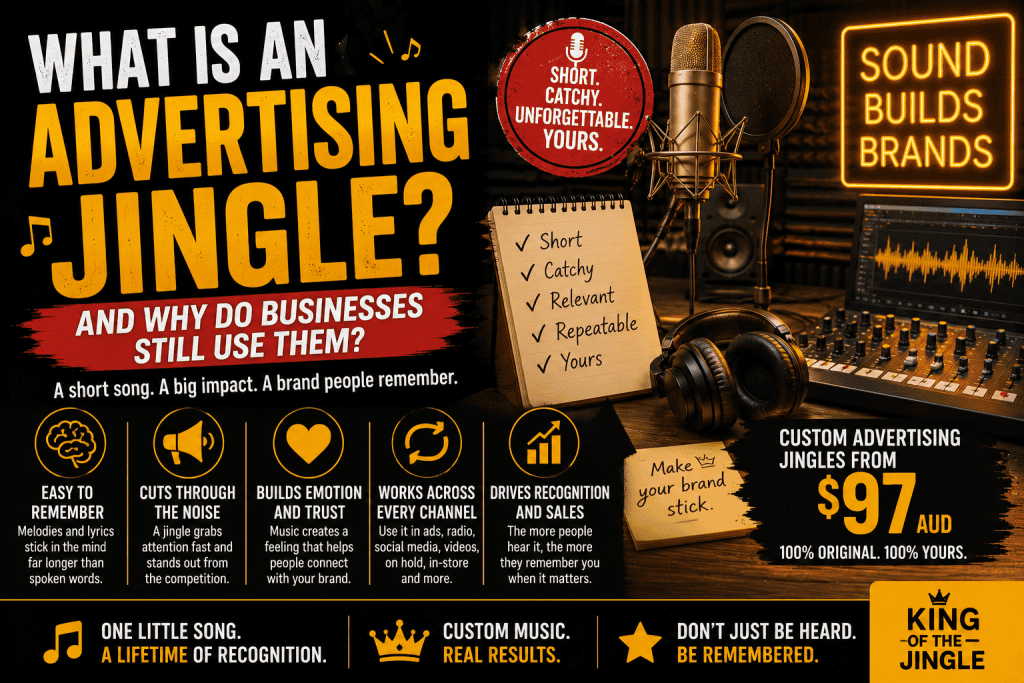
An advertising jingle is a short, memorable piece of music written to promote a business, product or service. It often includes the business name, a slogan or a simple message that the advertiser wants people to remember.
Jingles have been used in advertising for generations. The places we hear them have changed, but the job they do is still useful.
What is an advertising jingle?
An advertising jingle combines music with a marketing message.
Some jingles are complete short songs. Others are only a few seconds long. They may include lyrics, a sung business name, a slogan or simply a recognisable musical hook.
The goal is not to explain everything about the business.
The goal is to make an important part of the message easier to remember.
That is what separates a jingle from ordinary background music. Background music can create a mood. A jingle is written to carry part of the brand or advertising message.
Why do businesses use jingles?
Businesses use jingles because advertising needs to be remembered.
An advertisement can look great and still fail if people forget which business it was for.
A jingle can connect the memorable part of the advertisement directly to the brand. If the business name forms part of the hook, remembering the music can also help people remember the advertiser.
It also gives the business something it can repeat across different campaigns.
That repetition can help create familiarity over time.
Why can music be so memorable?
Music combines rhythm, melody and repetition. Those features can make information easier to recall.
Research into music and memory has found that melody can support recall in some situations. Advertising research also shows that distinctive audio cues can contribute to brand recognition when they are used well.
For a business, the practical lesson is simple.
If there is something you want customers to remember, putting it into a strong musical idea gives you another way to communicate it.
That does not mean every catchy song becomes good advertising. The music still needs to connect clearly with the business.
What does a jingle usually include?
A business jingle might include:
- the business name
- a short slogan
- a key product or service
- a simple customer benefit
- a memorable melody
- a repeated musical hook
- a call to action
Trying to include all of these at once can make a jingle crowded.
I normally think about what matters most.
If somebody remembers only one thing after hearing the music, what should that one thing be?
For many businesses, the answer is simply the business name.
Are advertising jingles old-fashioned?
No, but the way businesses use them has changed.
People often associate jingles with traditional radio and television commercials. Those formats still exist, but businesses now advertise through many more channels.
A modern jingle can appear in a Reel, TikTok, YouTube video, podcast advertisement, website video or paid social campaign.
It can also be much shorter than the jingles people remember from older television advertising.
A few seconds of distinctive music can sometimes do the job.
The format has changed. The need for recognition has not.
How are jingles used in modern advertising?
A business does not need to play the full song every time.
One custom jingle can be adapted into different versions for different marketing uses.
For example:
- a full version for a business video
- a 30-second advertising edit
- a 15-second social media version
- a short intro or ending
- an instrumental version
- a short sonic logo based on the main hook
This makes the music more flexible and helps the business keep a recognisable sound across its content.
I explain this in more detail in my guide to jingles for advertising.
What is the difference between a jingle and a brand song?
A jingle is usually built around a clear advertising purpose. It is often short and may put the business name or message directly into the music.
A brand song can be longer and feel more like a normal song. It may communicate the personality, story or feeling of the brand without sounding like a traditional advertisement.
The line between them can overlap.
For some businesses, a short direct jingle is the right choice. Others may benefit from a longer custom soundtrack that can be cut into smaller advertising pieces.
What is the difference between a jingle and sonic branding?
A jingle is one type of audio asset.
Sonic branding is the broader use of distinctive sound as part of a brand identity.
A business might have a full jingle and then use a short section of its melody as a sonic logo. That gives the business several related sounds built from one musical identity.
The jingle becomes part of a larger audio branding system.
Do small businesses need a jingle?
Not every business needs one.
If you rarely advertise or create content, custom music may not be a priority.
A jingle becomes more useful when your business communicates with customers regularly.
If you post videos, run advertisements, sponsor content, use radio or create regular social media, you have more opportunities to repeat the sound.
That repetition is important because recognition usually develops over time.
Can local businesses use jingles?
Absolutely.
In fact, local businesses are one of the reasons I became interested in creating this kind of music.
A café, restaurant, bakery, trades business, retailer or professional service may be competing against many businesses offering something similar.
They often have a logo and social media presence, but very few have a recognisable sound of their own.
I have created custom music around real local businesses and found that the most interesting part is translating what makes each business different into something people can hear.
A neighbourhood bakery should not sound like a nightclub. A family restaurant should not automatically sound like a corporate bank.
The music should fit the business.
What makes a good advertising jingle?
A good advertising jingle should be easy to understand, easy to recognise and appropriate for the brand.
It should also have a clear job.
Before I think about the musical direction, I want to understand the business. What does it sell? Who are its customers? What makes it different? Where will the music be used? What should people remember?
My background crosses songwriting, performing, DJing, business and digital marketing. That has shaped how I approach jingles.
I do not see the song and the marketing as separate things.
The music needs to work as music, but it also needs to work for the business.
Should a jingle include your business name?
Often, yes.
Including the business name can create a direct link between the musical hook and the brand.
That can be especially useful for smaller businesses that are still building name recognition.
It is not a rule. Some sonic identities work without lyrics at all.
But if the main goal is helping people remember who the advertisement belongs to, the business name deserves serious consideration.
Can you use the same jingle for years?
Potentially, yes.
A strong musical identity does not need to be thrown away every time an advertising campaign changes.
The arrangement can evolve. New versions can be produced. The length can change.
Keeping a recognisable core can help preserve the familiarity the business has built.
This is similar to updating a visual brand without necessarily abandoning every recognisable element.
How much does an advertising jingle cost?
The cost varies widely depending on the creator, production, length, revisions and usage rights.
I have put together a separate guide explaining how much a custom jingle costs in Australia.
At King of the Jingle, custom jingles start from A$97.
When comparing options, look beyond the price. Check what you receive, where you can use the music, how revisions work and whether the jingle is actually being created around your business.
How do you get an advertising jingle made?
You do not need to write the lyrics or know what musical style you want before contacting a jingle creator.
Start with information about your business.
Explain what you do, who your customers are, what makes you different and where you plan to use the music.
A good creative process can build the musical direction from there.
My guide on how to get a custom jingle made for your business walks through the process step by step.
Frequently asked questions about advertising jingles
How long is an advertising jingle?
There is no fixed length. A jingle can be a few seconds or a complete short song. The best length depends on where it will be used and what message it needs to carry.
Do jingles need lyrics?
No. A jingle can be instrumental, although lyrics can help when you want the business name, slogan or message built directly into the music.
Can a jingle be used on social media?
Yes, provided the usage rights cover those platforms. Jingles can be created for Reels, TikToks, YouTube videos, paid social advertising and other digital content.
Can I use one jingle in different advertisements?
Yes, depending on your licence. A core jingle can also be adapted into shorter edits and different arrangements for different campaigns.
Are jingles only for big companies?
No. Small and local businesses can use custom jingles to create a recognisable sound across their advertising and content.
Give people another way to remember your business
Your logo gives people something to recognise with their eyes.
A jingle can give them something to recognise with their ears.
For me, that is the real value of an advertising jingle.
It is not about making an advertisement sound like it came from another era. It is about using music deliberately so the business becomes easier to remember.
King of the Jingle creates custom jingles and brand songs for businesses, with packages starting from A$97.
Get your own custom jingle and give your business a sound people can remember.