

Your business probably has a visual identity. You might have a logo, colours, fonts and a particular style you use across your marketing.
Sonic branding applies the same thinking to sound.
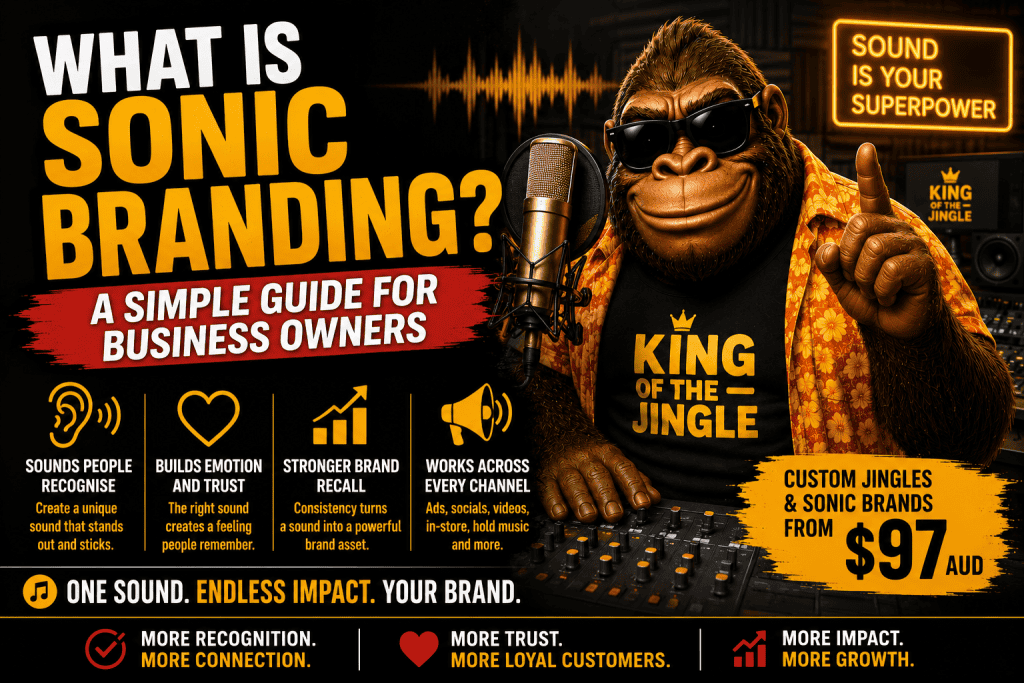
Sonic branding is the deliberate use of distinctive sound to help people recognise and identify a brand. It can include a short sonic logo, a jingle, a musical hook, a brand soundtrack, a voice or other recurring audio elements.
For a small business, the idea is simple. Instead of choosing unrelated music every time you make a video or advertisement, you can develop a sound that belongs to your business.
What is sonic branding?
Sonic branding is the use of consistent audio elements as part of a brand identity.
The sound might last only a few seconds. It might also be a longer piece of music that can be adapted for different uses.
The key word is recognition.
Random background music can make a video feel better. Sonic branding tries to do something more. It gives people an audio cue they can learn to associate with your business.
That makes it the sound equivalent of using a recognisable logo or colour palette.
What can be part of a sonic brand?
A sonic identity can include several types of sound:
- a sonic logo or short audio sting
- a custom business jingle
- a sung business name
- a recurring melody or musical hook
- custom brand music
- a longer business soundtrack
- a consistent voice or vocal style
- sound effects used repeatedly with the brand
You do not need all of these.
For many small businesses, one strong musical idea that can be reused in several ways is a much more practical starting point.
What is a sonic logo?
A sonic logo is a very short and distinctive sound used to identify a brand.
It is usually only a few seconds long. You might hear it at the end of an advertisement, when an app opens, during a video intro or at another moment where the business wants to signal its identity.
Its job is similar to a visual logo. It does not need to explain everything the business does. It needs to become recognisable.
Is sonic branding the same as a jingle?
No. A jingle can be part of sonic branding, but sonic branding is the broader idea.
A jingle is usually a piece of music written for a business or advertising message. It may contain lyrics, the business name or a memorable phrase.
Sonic branding can include that jingle, but it can also include shorter sounds and other recurring audio elements.
For example, a business might have a full custom jingle for promotional videos and use a three-second musical section from it as a recurring audio signature.
That creates a family of sounds rather than starting from zero every time.
What is the difference between sonic branding and audio branding?
The terms sonic branding and audio branding are often used to describe very similar ideas.
Both involve building brand recognition through sound. Some people use sonic branding to describe the distinctive sounds themselves, while audio branding can describe the wider strategy around how a business uses sound.
For a small business owner, the practical difference is usually less important than the goal.
Your sound should feel like your business, be recognisable and work consistently wherever customers hear you.
If you want the broader explanation, I have also written a guide to audio branding for small businesses.
Why would a business use sonic branding?
Businesses use sonic branding to create another way for customers to recognise them.
That matters because branding does not only happen when somebody is staring at your logo.
People hear businesses in videos, advertisements, podcasts, stores, phone systems, apps and social media. Sound can become part of the identity in those moments.
There is evidence behind the broader idea of distinctive audio assets. An Ipsos meta-analysis of more than 2,000 pieces of video creative found that brand assets were linked with stronger branded attention, and sonic brand cues performed particularly strongly within the audio assets studied.
That does not mean adding a sound automatically makes advertising work. The sound still needs to be distinctive, appropriate and used consistently.
Can small businesses use sonic branding?
Yes. Sonic branding is not limited to global companies with huge advertising budgets.
A small business can start with one useful audio asset and build from there.
Imagine a local restaurant that creates regular Reels, runs social ads and posts weekly specials.
It could use a recognisable custom musical hook across those videos. A longer version might sit under a promotional video. A shorter version could finish a Reel. A sung version of the restaurant name could appear in an advertisement.
The business now has a common sound connecting different pieces of content.
That is sonic branding at a small-business scale.
Sonic branding versus using trending music
Trending music can help a piece of content fit the style of a platform. It can also be useful when a particular trend makes sense for your audience.
But the music belongs to the trend, not to your brand.
When the trend changes, your sound changes with it.
Custom sonic branding takes the opposite approach. It gives you something consistent that can travel between campaigns and platforms.
You do not necessarily need to choose one forever. A business can still use trends where they make sense while keeping recognisable audio elements of its own.
Where can a small business use its sonic identity?
A business can use a sonic identity anywhere sound forms part of the customer experience, subject to the rights and licence attached to the music.
Common uses include:
- Instagram Reels
- TikTok videos
- YouTube videos and Shorts
- Facebook and Instagram advertising
- radio advertising
- podcasts
- website videos
- business presentations
- promotional videos
- in-store audio
- events
The real benefit comes when customers encounter related sounds in more than one place.
What makes sonic branding effective?
Good sonic branding needs to be distinctive enough to belong to the business and flexible enough to use in real marketing.
From my experience creating music for businesses, one of the biggest mistakes is thinking only about whether a piece of music sounds good.
That matters, but I also ask a more practical question: what part of this sound could somebody associate with the business?
A great track can create atmosphere. A useful brand sound needs an identifiable idea.
That might be a melody, rhythm, sung name, vocal phrase or another musical cue. I keep the detailed songwriting system private, but the broad principle is straightforward. The sound needs a reason to belong to that particular business.
Does sonic branding have to sound corporate?
No.
A local café, builder, restaurant, beauty business and accounting firm should not all sound alike.
The sound should suit the personality of the business and the people it wants to reach.
A playful brand might use something energetic and cheeky. A premium service might need a cleaner and more restrained sound. A family restaurant might want warmth and energy.
There is no universal sonic-branding style.
The identity comes from making the sound fit the brand.
How is a sonic identity created?
Start with the business, not the music genre.
Think about who your customers are, what you want them to remember, how your brand should feel and where the sound will actually be used.
From there, a creator can develop a musical direction and create an audio asset that works with your marketing.
You do not need to know music theory or arrive with a melody. A useful brief about your business is more important.
If you are considering having one created, my guide on how to get a custom jingle made for your business explains what to prepare and what to expect.
Can you use one sonic identity across different types of content?
Yes. That is one of its most useful features.
The exact recording does not need to appear unchanged in every piece of content.
A core musical idea can be adapted into different lengths and arrangements while retaining something recognisable.
For example, a business could use a longer version in a brand video, a shorter edit in an advertisement and a brief ending on social content.
This gives your content variety while keeping a connection between it.
Is sonic branding worth it for a small business?
It can be, particularly if you create content or advertise regularly.
If you make one video every two years, building a sonic identity may not be a priority.
If your business publishes Reels, runs ads, creates videos or promotes itself often, having your own reusable sound becomes more useful.
Instead of treating music as a new decision every time, you begin building an audio asset that can stay with the business.
That is the part of sonic branding I think small businesses often overlook.
You do not need to behave like a multinational company. You simply need to stop thinking of sound as disposable.
Frequently asked questions about sonic branding
How long is a sonic logo?
A sonic logo is normally very short, often only a few seconds. Its purpose is quick brand identification rather than delivering a full advertising message.
Does sonic branding need lyrics?
No. Sonic branding can be completely instrumental. Lyrics or a sung business name can be useful when they suit the brand and purpose.
Can a jingle become a sonic logo?
Yes. A recognisable musical section from a longer jingle can sometimes be adapted into a short audio signature.
Can sonic branding be used on social media?
Yes. Custom brand sounds can be used in Reels, TikToks, Shorts and other social content when the relevant usage rights allow it.
Is stock music sonic branding?
Usually not by itself. Stock music can support the mood of content, but sonic branding is built around distinctive and consistent audio cues associated with a particular brand.
Give your business a sound of its own
Sonic branding does not have to begin with a huge strategy.
It can start with one recognisable piece of custom music that fits your business and can be reused across your marketing.
King of the Jingle creates custom jingles and business soundtracks designed around real businesses and the content they create.
If you are still exploring the idea, listen to custom business soundtrack examples and hear how different businesses can have completely different musical identities.
Research reference: Ipsos, “The Power of You”, a meta-analysis of 2,015 US video advertisements examining distinctive brand assets and branded attention.