

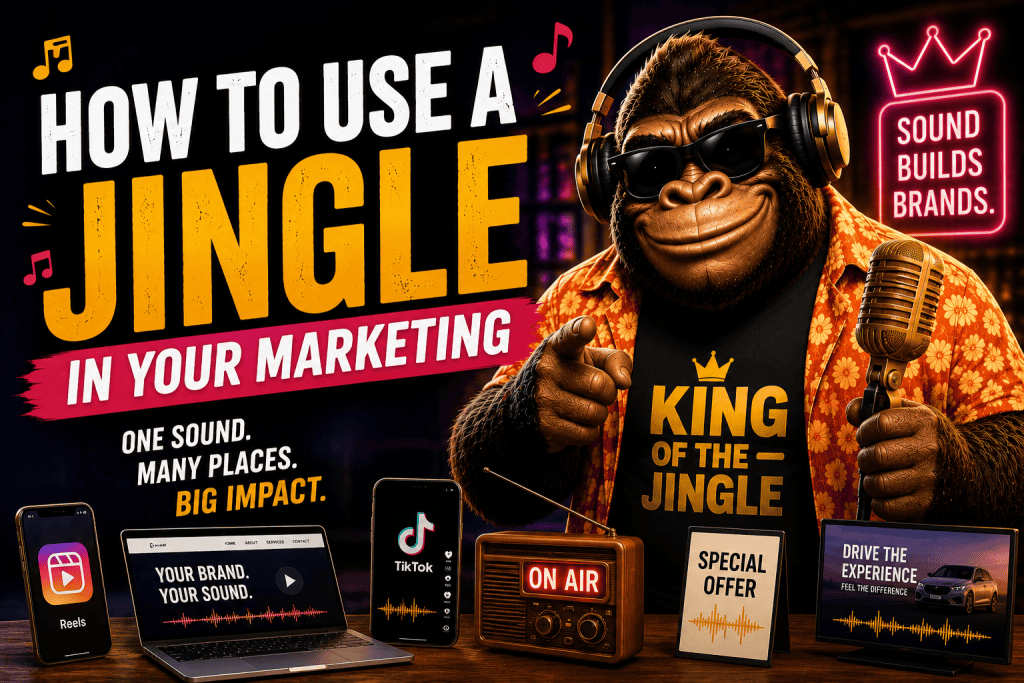
Getting a custom jingle made is only the beginning.
The real value comes from using it.
A business jingle can become part of your social media, advertising, website, videos and other customer touchpoints. You do not need to play the full song every time. In many cases, a few recognisable seconds are enough.
The best way to use a jingle in your marketing is to repeat recognisable parts of it across the places customers regularly see and hear your business.
Here are practical ways to do that.
1. Use your jingle in social media videos
Social media is one of the easiest places to start.
Your jingle can sit under Instagram Reels, TikToks, Facebook videos and YouTube Shorts.
You might use the full track for a longer business feature, an instrumental section behind talking, or a short hook at the beginning or end of each video.
The important part is consistency.
If viewers repeatedly hear a recognisable musical element when they see your business, the sound has a chance to become familiar.
I have covered this in more detail in my guide to custom music for social media.
2. Finish your videos with a short jingle sting
You do not need a 30-second song at the end of every Reel.
Take one recognisable part of your jingle and turn it into a short ending.
This could be a sung business name, a musical hook or a few seconds that play as your logo appears.
Using the same ending repeatedly can give separate videos a common identity.
It is a simple way to start building sonic branding without making every piece of content sound the same.
3. Use your jingle in paid advertising
If you run video or audio ads, your jingle can help connect the advertisement to your business.
It can work in Facebook and Instagram ads, YouTube advertising, radio commercials, podcast ads and other formats where sound is available.
For short ads, get to the recognisable part quickly. You may only have a few seconds before somebody scrolls or skips.
A longer version can work when the format gives you more time.
Make sure your music licence covers paid advertising before using it this way.
For more ideas, see my guide to using jingles in advertising.
4. Put your jingle on your website
Your website gives you several opportunities to use custom music without making it autoplay when somebody arrives.
Autoplaying music can annoy visitors, so give people control.
Better options include adding your jingle to a brand video, product demonstration, customer story or portfolio section.
You can also create a simple “hear our jingle” button if the music itself is part of your story.
For a business using video on its homepage or landing pages, custom music can help make that content feel more connected to the brand.
5. Use it in your YouTube videos
If your business has a YouTube channel, your jingle can become part of the channel’s identity.
You could use a short version in the intro, outro or both.
Keep intros brief. People usually came for the video, not a long opening sequence.
A recognisable few seconds can do the branding job without delaying the content.
Longer sections of the music can also work under montages, product footage, behind-the-scenes scenes and promotional videos.
6. Create several versions from one jingle
This is one of the most useful things you can do.
Instead of treating your jingle as one fixed audio file, turn it into a small collection of marketing assets.
For example:
- the full jingle
- a 30-second version
- a 15-second version
- a five-second sting
- an instrumental version
- a version with the business name at the end
Now you can choose the right version for the job while keeping the core sound consistent.
7. Use instrumental versions under talking
Lyrics can compete with somebody speaking in a video.
An instrumental version solves that problem.
Use it quietly under an owner introduction, product explanation, testimonial or voice-over.
Then bring the vocal hook back at the end when nobody is speaking.
This lets the jingle support the content without making the words harder to hear.
8. Add it to promotional and product videos
A promotional video is an obvious place for custom music because the entire piece is already about the business.
Your jingle can support footage of products, staff, customers, your location or the work you do.
The music can also help set the pace of the edit.
For local businesses, this can work particularly well with short feature videos. A café might show food being prepared. A builder might show a project taking shape. A retailer might introduce a new range.
The visuals show what the business does. The music helps identify who the video belongs to.
9. Use your jingle in podcast advertising
If you advertise on podcasts, a short musical cue can help separate your message from the surrounding programme.
You might open with the hook, deliver the spoken offer and finish with the sung business name.
This gives listeners an audio cue at both ends of the advertisement.
If your business produces its own podcast, a short version can also work as an intro or outro.
10. Use it in radio advertising
Radio is the traditional home of the advertising jingle, and the format still makes sense because everything has to work through sound.
A jingle can carry the business name, support the spoken message or finish the advertisement with a recognisable hook.
Different edits can be created for different commercial lengths.
Keep the main message clear. The music should help listeners remember the business rather than trying to squeeze every detail into the song.
11. Use it at events and presentations
If your business appears at trade shows, community events, conferences or presentations, your jingle can become part of the experience.
Use it when a presentation begins, during a promotional video, before an announcement or as people approach your display.
A short branded sound can also make transitions in a presentation feel more deliberate.
Again, check that your usage rights cover the setting.
12. Use it in-store
Businesses with physical locations may be able to use custom music in-store.
A restaurant, retailer, showroom or service business could include its own music in approved in-store audio, digital displays or promotional videos.
How this works depends on the location, playback system and rights involved, so check those details before putting music into regular rotation.
13. Build it into recurring content
Recurring content gives your jingle a natural home.
If your business posts a weekly tip, product of the week, customer story or regular video series, use the same short musical cue each time.
People can begin learning that the sound means a familiar piece of content is starting.
This is where repetition becomes useful rather than repetitive. The music has a clear job.
14. Match different parts of the jingle to different content
You do not have to use the catchiest part every time.
A full song may contain several useful moments.
An energetic section might suit a product reveal. A quieter instrumental part might work behind speech. The main vocal hook might suit the ending.
Think of the jingle as a source of reusable audio rather than one file that must always play from beginning to end.
15. Let customers hear it more than once
A recognisable sound needs repetition.
If you use your jingle once and then forget about it, you lose much of the branding opportunity.
That does not mean playing it constantly.
Choose a few repeatable places where the sound naturally fits and keep using it there.
Your video ending, social series, advertisements and brand videos might be enough.
Over time, those repeated encounters can help the sound become connected with your business.
What should you avoid when using a business jingle?
Do not force the entire song into every piece of marketing.
Do not make the music so loud that people cannot hear your message.
Do not use a long intro that makes viewers wait for the content.
Do not keep changing the recognisable part so much that nothing stays familiar.
And do not assume your licence covers every possible use.
The goal is not maximum jingle.
The goal is useful, consistent branding.
How often should a business use its jingle?
There is no perfect number.
Use it often enough that regular customers have opportunities to recognise it, but not so often that it becomes annoying or gets in the way of the content.
Consistency matters more than putting it everywhere.
Choose the marketing channels you actually use and build the sound into those.
Can an old jingle be reused in new marketing?
Potentially, yes.
If you own or have the necessary rights to an existing jingle, it may be possible to create new versions for modern marketing.
The melody could be rearranged, shortened or adapted for social video while keeping the part customers already recognise.
Before changing or reusing an older jingle, confirm who owns the composition and recording and what your rights allow.
How does a jingle become part of your brand?
A jingle becomes more valuable as a branding asset when people encounter recognisable parts of it repeatedly.
That connects with the wider idea of audio branding.
Your visual logo stays recognisable across different designs. Your core sound can work in a similar way across different pieces of marketing.
The campaign can change while the audio identity stays familiar.
Frequently asked questions about using a jingle
Can I use my jingle on Instagram and TikTok?
Yes, if your music rights cover the intended social media use and you follow the platform’s current rules for business and commercial content.
Can I use the same jingle in paid ads?
Potentially, yes. Check that your licence includes paid advertising and the platforms or media you plan to use.
Should I put my whole jingle in every video?
No. Short edits, instrumental sections and brief musical hooks are often more useful for video content.
Can I put a jingle on my website?
Yes, subject to your rights. It is usually better to let visitors choose to play audio rather than forcing music to autoplay.
Can I turn my jingle into a sonic logo?
Yes. A short, recognisable part of a jingle can sometimes be adapted into a sonic logo or audio sting for repeated brand use.
Make your jingle earn its place in your marketing
A custom jingle should not sit forgotten in a folder after it is delivered.
Use it.
Cut it into useful versions. Put it into the content you already create. Give customers repeated chances to connect the sound with your business.
That is how a piece of music starts becoming a brand asset.
King of the Jingle creates custom jingles and business soundtracks designed to work across real marketing.
If you do not have one yet, my guide to getting a custom jingle made explains what to expect.
Get your own custom jingle and start putting your business sound to work.