

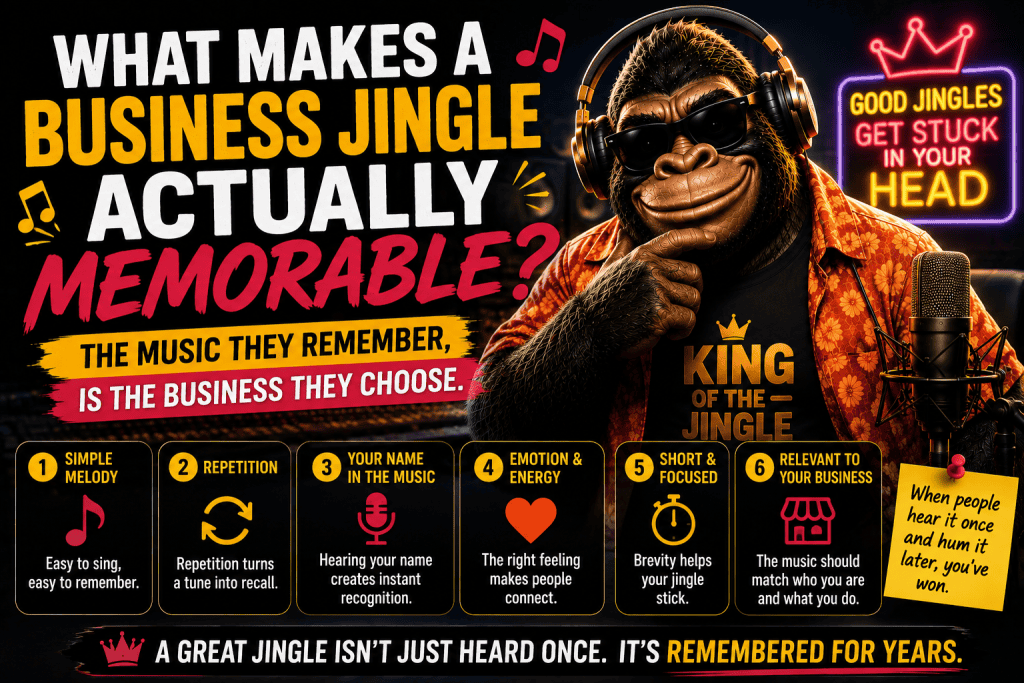
Some jingles disappear the moment an advertisement ends.
Others stay in your head for years.
You might remember the melody, the rhythm or the way the business name was sung, even when you have not heard the advertisement for a long time.
So what makes the difference?
A memorable business jingle usually combines a simple musical idea, a clear connection to the brand and enough repetition for people to learn it.
Catchiness matters, but there is more to it than writing a tune that gets stuck in your head.
1. A memorable jingle has a clear job
Before writing music, you need to know what people should remember.
Is it the business name?
A product?
A short message?
A feeling?
Trying to make listeners remember everything usually makes the jingle weaker.
A strong jingle gives the audience something clear to hold onto.
For many small businesses, that may simply be the business name attached to a recognisable musical hook.
2. Simple ideas are easier to remember
Complex music can be brilliant music.
But a business jingle has a different job.
People are usually not sitting down specifically to study it. They hear it while watching a video, scrolling social media, listening to an advertisement or doing something else.
That means the main idea needs to be easy to follow.
A simple melody, short phrase or clear rhythm gives listeners a better chance of remembering it after the content has finished.
Simple does not mean boring. It means the important part is easy to recognise.
3. Repetition helps people learn the hook
Repetition is one of the basic tools of a jingle.
A business name or musical phrase can become easier to remember when listeners hear it more than once.
But repetition needs judgement.
Repeat too little and the hook may never settle in. Repeat too much and the song can become irritating.
The aim is to reinforce the important idea without making the listener feel trapped inside it.
4. The business name can become part of the melody
One of the most useful things a jingle can do is connect the business name directly to music.
Instead of saying the name over background music, the name becomes part of the musical hook itself.
That creates a stronger link between what people hear and what you want them to remember.
If somebody later recalls the melody and automatically hears the business name with it, the music is doing useful branding work.
This is one reason an advertising jingle can do something ordinary background music cannot.
5. Rhythm matters as much as melody
People often talk about catchy melodies, but rhythm plays a major role too.
The way words sit against the beat can make a phrase feel natural and memorable.
A business name has its own pattern when you say it aloud. Good jingle writing pays attention to that.
Forcing words awkwardly into a melody can make the brand name harder to understand.
The musical rhythm should help the words land clearly.
6. The words need to sound natural
A jingle is still communication.
If the lyrics sound like somebody copied a brochure into a song, listeners will notice.
Business language that works on a website does not always work when sung.
Shorter phrases usually give the music more room and make the message easier to understand.
The words should sound like something a person could actually say, remember and repeat.
7. The hook should arrive before attention disappears
This matters even more in modern advertising.
People can scroll past a video in seconds.
If the most recognisable part of your jingle takes a minute to arrive, many people will never hear it.
That does not mean every song must start with the chorus.
It means you should create versions that suit the way the music will be used.
A short social edit may reach the hook immediately, while a longer brand song can take more time to develop.
My guide to business jingle length explains why several edits can be useful.
8. The music should fit the business
A memorable tune is not enough if it feels disconnected from the brand.
A children’s entertainment business, an accountant, a café and a building company should not automatically sound the same.
The musical choices should make sense for the business and the customers it wants to reach.
This does not mean following stereotypes.
It means understanding the personality the business wants to communicate.
When the sound and the business feel connected, the jingle has a better chance of becoming a genuine brand asset.
9. Distinctive beats generic
There is plenty of music that sounds good but could belong to almost any business.
That can work perfectly well as background music.
A jingle needs something more if its job is recognition.
The distinctive element might be the melody, vocal delivery, rhythm, lyric, sound or a combination of them.
You want something customers can begin associating with your business rather than simply thinking, “That was nice music.”
This is the key difference I explored in Stock Music vs a Custom Business Soundtrack.
10. Emotion can strengthen memory
Music can create a feeling quickly.
A jingle might feel fun, warm, energetic, confident, cheeky or reassuring depending on the business.
That emotional character can help the music feel more meaningful than a list of product features.
But the emotion needs to suit the brand.
A memorable sound that creates the wrong feeling is not a branding win.
11. Clear vocals matter
If the jingle contains important words, people need to understand them.
A clever lyric has little value when the business name disappears under the music.
The vocal performance, arrangement and mix all need to leave enough space for the key words.
This becomes especially important on phones, small speakers and noisy social media environments.
Test whether the important phrase can still be understood outside a perfect studio listening setup.
12. A jingle needs to survive shorter edits
A useful musical idea should still be recognisable when the full song is not playing.
Can the main hook work in 15 seconds?
Can part of it become a five-second ending?
Can an instrumental version sit under somebody talking?
If so, the jingle becomes much easier to use across real marketing.
That matters because repetition often happens across different formats rather than through one advertisement played again and again.
13. Consistent use makes a jingle more memorable
Even an excellent jingle cannot become familiar if nobody hears it.
Businesses sometimes invest in custom music, use it once and then move on to something completely different.
That throws away much of the opportunity.
You do not need to put the whole song into every advertisement.
Instead, reuse recognisable elements across the marketing you already create.
A short hook might appear in Reels, video ads, YouTube content and your website videos.
My guide to using a jingle in your marketing gives practical examples.
14. Familiarity takes time
It is easy to judge a jingle after hearing it once.
Your customers may need repeated exposure before the sound feels familiar.
That is normal.
Visual branding works the same way. A logo becomes recognisable because people encounter it repeatedly.
Audio can build recognition through repeated use too.
This is part of the wider idea of sonic branding.
15. Annoying is not the same as memorable
People sometimes assume the goal of a jingle is to annoy somebody until they cannot forget it.
I do not think that is a good standard.
A sound can be memorable because it is distinctive, enjoyable and strongly connected to the business.
You want customers to recognise the brand, not reach for the mute button every time it appears.
Repetition should build familiarity rather than punish the listener.
Does a jingle need to rhyme?
No.
Rhyme can make lyrics satisfying and easier to predict, but it is only one songwriting tool.
Forcing a bad rhyme can make a business sound awkward.
Melody, rhythm, repetition and clear phrasing can create memorability without every line rhyming.
Does the business name need to be repeated?
Not always, but the name should be easy to identify if brand recall is the goal.
Sometimes repeating it works.
Sometimes singing it once in the strongest part of the hook is enough.
The decision depends on the structure of the jingle and how the finished music will be used.
Can an instrumental jingle be memorable?
Yes.
Words are not required for audio recognition.
A distinctive instrumental melody or short sonic logo can become associated with a brand through consistent use.
For small businesses, including the name can sometimes make the connection more direct, but an instrumental identity can work when it has a clear role and is used consistently.
What I listen for when creating a business jingle
I have spent decades around songwriting, performing and DJing, and I also come from a digital marketing background.
Those two sides matter when I think about memorability.
I am listening for whether the musical idea works, but I am also asking what the customer is likely to take away from it.
Can they understand the business name?
Is there a clear hook?
Does the sound fit the business?
Can useful shorter versions come from it?
Does it give the business something it can actually use in its marketing?
I keep my detailed creative process private, but those practical questions shape the work.
How can you make an existing jingle more memorable?
Sometimes the answer is not writing an entirely new song.
An existing jingle may already contain a strong musical idea that is buried inside a long arrangement.
You might create a tighter edit, bring the business name forward, simplify the hook or develop a short brand sting from the strongest section.
If customers already recognise part of an older jingle, keeping that familiar element may be more valuable than throwing everything away.
Make sure you have the rights required to edit or reuse existing music before changing it.
Frequently asked questions about memorable jingles
What makes a jingle catchy?
A clear melody, strong rhythm, simple phrasing and repetition can all contribute to catchiness. For business use, the hook should also connect clearly to the brand.
Should a jingle include the business name?
It often helps when name recognition is the goal because the music and brand name can be learned together. It is not compulsory for every type of audio branding.
How many times should a business name be repeated?
There is no fixed number. Repeat it enough to support the hook without making the jingle feel forced or irritating.
Can a short jingle be memorable?
Yes. A few distinctive seconds can be enough when the musical idea is clear and customers hear it consistently.
Why do some jingles stay in your head?
Simple musical patterns, repetition, rhythm and distinctive hooks can make them easier to recall. Repeated exposure can strengthen that familiarity over time.
Memorable does not happen by accident
A business jingle needs to do more than sound good once.
It needs a clear idea people can recognise and a connection to the business they can remember.
Keep the important part simple. Make the brand clear. Give the hook room to work. Then use it consistently enough for customers to learn it.
That is when a song can start becoming part of how your business sounds.
King of the Jingle creates custom jingles and business soundtracks built around real businesses and the things they want customers to remember.
Get your own custom jingle and give your business a sound people can recognise.