

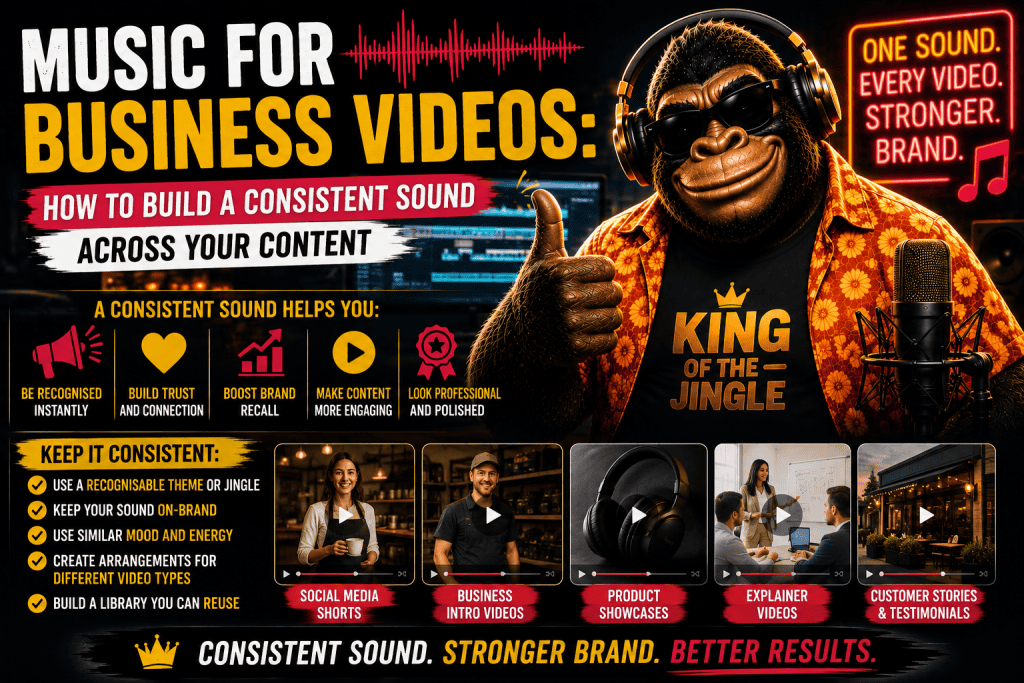
Your business videos probably share the same logo, colours and visual style.
But what do they sound like?
Many businesses choose music one video at a time. One Reel gets a trending song. The next gets a stock track. A product video uses something completely different.
Each track may work on its own, but there is little connecting the videos through sound.
A consistent sound gives your business videos recognisable audio elements that can carry across Reels, TikToks, YouTube, advertisements and website content.
You do not need to use exactly the same song every time. You need enough consistency for the content to feel like it comes from the same business.
Why does music matter in business videos?
Music does several jobs at once.
It can create energy, support emotion, help set the pace of an edit and make a video feel more complete.
For a business, it can also help with recognition.
When customers repeatedly hear familiar audio alongside your brand, the sound can begin to become part of the identity of the content.
That turns music from something you add after editing into something you can plan as part of your marketing.
What does a consistent business sound mean?
Consistency does not mean every video needs the same soundtrack from beginning to end.
It means retaining recognisable audio elements across different content.
That could include:
- the same short musical hook
- a recurring intro or outro
- a sung business name
- instrumental versions of the same music
- a sonic logo
- several edits built from one custom soundtrack
The individual videos can still have different moods and purposes.
The common audio elements give them a family resemblance.
Start with the videos you actually make
Do not build an audio strategy around content your business never creates.
Look at what you already publish.
Do you make Reels every week?
Product demonstrations?
Customer testimonials?
YouTube videos?
Paid video ads?
Behind-the-scenes clips?
Website videos?
Your sound should fit those real uses.
A local café posting short social videos needs a different set of audio assets from a company producing ten-minute YouTube explainers.
Create one core musical identity
A practical starting point is one main piece of custom music.
That could be a jingle, brand song or instrumental business soundtrack.
The goal is to create a recognisable musical idea that can survive different edits.
Instead of finding unrelated music every time, you have a core sound to work from.
This is where audio branding starts becoming useful for everyday content rather than something reserved for large companies.
Turn one track into several useful versions
A full song is not going to fit every video.
That is why versions matter.
From one core track, you might create:
- a full version
- a 30-second edit
- a 15-second edit
- a five-second sting
- an instrumental version
- a version that ends with the business name
Now the music can adapt to the content without losing its identity.
A Reel might use five seconds. A product video might use the instrumental. A longer brand video might use the full track.
The sound stays connected even when the format changes.
Use short audio cues at repeatable moments
One of the easiest ways to build consistency is to choose repeatable moments in your videos.
For example, the same short sound might play when your logo appears at the end.
A weekly video series might always begin with the same two or three seconds.
A product reveal could use a recognisable musical cue.
These moments give the audio a clear job.
They also let you use a branded sound without forcing a full jingle into every piece of content.
Use instrumental music under speech
Talking videos create a common problem.
If the soundtrack has vocals, those words can compete with the person speaking.
An instrumental version gives you the same musical identity without fighting the voice.
Keep it low enough that the speaker remains clear.
Then you can bring the vocal hook or sung business name back at the end.
This works well for owner introductions, testimonials, demonstrations, explainers and voice-over videos.
How should music work in Instagram Reels?
Reels move quickly, so your branded audio does not need to take over the whole video.
A short opening or ending can be enough.
You can also place an instrumental section underneath the video and save the recognisable hook for the strongest brand moment.
There will still be times when trending audio makes sense.
Using a trend does not mean abandoning your own sound. Choose based on the purpose of the post.
My guide to custom music for social media goes deeper into this.
How should music work in TikTok videos?
TikTok is heavily driven by sound, trends and fast-moving formats.
Your business does not need to ignore that culture.
Use trending sounds when they genuinely suit the content.
Use your own branded music when the business itself is the focus and you want the content to strengthen recognition.
You can also build recurring video formats around your own short musical cue.
The important thing is knowing why you chose the sound rather than adding whatever is popular that day.
How should music work in YouTube videos?
YouTube gives you more room to develop a consistent audio identity.
A short branded intro can work, but keep it brief. Viewers should not have to sit through a long opening before reaching the content they clicked for.
An instrumental version can run quietly under sections of the video.
A short outro can bring the recognisable hook back as you show your logo, contact details or next video.
For longer promotional videos, the full custom soundtrack may have room to develop naturally.
How should music work in video advertising?
Advertising needs the music to support the marketing message.
In a short ad, you may want the recognisable audio element to arrive quickly.
If somebody is speaking, use music that leaves space for the voice.
Then use the strongest brand cue at a point where viewers can clearly connect it with your business name or logo.
Repeated campaigns can use different edits while keeping the same core musical identity.
That is one of the advantages of using custom jingles in advertising.
How should music work on your website?
Website video can use the same audio identity as your social content.
A homepage brand video, customer story or product demonstration can use versions of the music customers may already have heard elsewhere.
Avoid forcing music to autoplay when somebody visits your site.
Give visitors control over audio and let the music support the video rather than interrupt the browsing experience.
Should every business video use music?
No.
Some videos are stronger without it.
A serious announcement, simple piece of advice or direct-to-camera message may not need a soundtrack.
Consistency does not mean adding music where it does not belong.
It means that when you do use branded audio, the choices connect.
What about stock music?
Stock music can still have a place in your video strategy.
You may need a mood or style that your core business soundtrack does not provide.
Or you may be creating a one-off video where custom music adds little value.
The problem comes when every video uses unrelated stock tracks and you expect the music to help build brand recognition.
If you are deciding between the two approaches, read Advertising Music: Stock Music vs a Custom Business Soundtrack.
What about trending music?
Trending music can help a business participate in a format people already understand.
It can also make sense when the trend itself is part of the joke, idea or conversation.
But trending audio builds recognition for the song or trend before it builds recognition for your business.
You do not have to choose one approach forever.
Use trends when they serve the content. Use your own sound when you want the content to serve the brand.
Keep your music recognisable without becoming repetitive
This is the balance.
If every video starts with the exact same 20 seconds, regular viewers may get tired of it.
Instead, use variations.
Change the length. Use an instrumental. Start at a different point. Keep the same melody but adapt the arrangement. Use only the final brand sting.
The connection stays while the content still feels fresh.
Match the energy of the music to the video
A consistent sound still needs flexibility.
A fast product montage and a calm customer story may need different energy.
If your custom music has been designed with several usable sections or arrangements, you can choose the version that fits.
The goal is not to make every emotion identical.
The goal is to retain enough musical identity that the different versions still belong to the same brand.
Make sure the business name stays clear
If your music includes the business name, protect that moment.
Do not bury it under speech, sound effects or a busy edit.
Give viewers a chance to hear it clearly while they can also see the business on screen.
That combination can help connect the sound, name and visual identity.
This is one of the ingredients I covered in What Makes a Business Jingle Actually Memorable?
Think about sound before you finish the edit
Music works better when it is considered early.
If you wait until the video is completely finished and then search for something to fill the silence, the soundtrack becomes an afterthought.
Knowing the music beforehand can help with pacing, cuts and the timing of important brand moments.
You do not need to edit every video directly to the beat, but the picture and sound should feel like they belong together.
Build a simple audio toolkit
You do not need dozens of tracks.
A small business can start with a simple toolkit:
- one main custom track
- one instrumental version
- one short social edit
- one five-second brand sting
That gives you enough flexibility for many common videos.
You can add more versions later when a real need appears.
Keep your audio files organised
This sounds basic, but it matters.
Name each version clearly so whoever creates your videos knows what to use.
For example:
- Brand Song Full
- Brand Song Instrumental
- Brand Song 15 Seconds
- Brand Sting 5 Seconds
Keep the licence or usage agreement with the files too.
That becomes especially useful when staff, freelancers or agencies create content for you later.
Check your music rights before publishing
Having an audio file does not automatically mean you can use it everywhere.
Make sure your rights cover the platforms and uses you need, particularly paid advertising.
If you commission custom music, discuss social media, websites, YouTube, paid ads and other intended uses before the project begins.
This avoids finding out later that an important use is outside the licence.
How I think about music for business video
My background sits across music and marketing.
I have spent decades writing songs, performing and DJing, and I have also worked in digital marketing.
So when I think about music for a business video, I am not only asking whether the track sounds good.
I am asking what the video needs to achieve.
Where will people see it?
What should they remember?
Can the sound be reused in the next video?
Does it help connect separate pieces of content back to the same business?
I keep my detailed creative process private, but those marketing questions are a major part of how I approach business music.
A simple example
Imagine a local restaurant creates four videos in a month.
The first shows a new dish. The second introduces the chef. The third promotes a special offer. The fourth is a customer feature.
They do not need four unrelated soundtracks.
The food montage could use an energetic section of the custom track.
The chef interview could use the instrumental quietly underneath.
The offer video could use a 15-second edit.
The customer feature could finish with the five-second sung business name.
Four different videos. One connected sound.
Frequently asked questions about music for business videos
Should I use the same music in every business video?
No. Use recognisable elements consistently, but vary the length, arrangement or section to suit the content.
Can I use custom music in Reels and TikToks?
Yes, when your usage rights cover those platforms. Short edits and instrumental versions can be especially useful for social video.
Is stock music bad for business videos?
No. Stock music can be a good choice when you simply need background music. It is less useful when you want the sound itself to become distinctive to your brand.
How loud should background music be under speech?
Quiet enough that every word remains easy to understand. Test the finished video on ordinary phone and laptop speakers, not only studio headphones.
Do I need a full jingle for video branding?
No. A short musical hook or sonic logo can be enough. A full jingle gives you more material that can be adapted into different versions.
Make your videos sound like they belong to your business
Businesses already understand visual consistency.
Your logo does not change every week. Your colours do not start from scratch with every post.
Your video sound can have consistency too.
Start small. Build one strong musical identity. Create a few useful versions and put them into the content you already make.
Over time, your videos can begin to sound as recognisable as they look.
King of the Jingle creates custom jingles and business soundtracks designed to work across real marketing content.
Get your own custom business soundtrack and start building a consistent sound across your videos.